jueves, 25 de febrero de 2016

Press release on EU "Science for Environmental Policy"

The work by Rosanna di Maggio et al.  on lesser kestrel demography has been mentioned in "Science for Enviornmental Policy" of the European Commission.
The study found that early-spring harvested crops, such as artichokes, offer a positive alternative habitat compared to those crops harvested in late spring.  Form the press note: "[...] Intensive activities in artichoke fields, including field preparation, planting, and fertiliser and pesticide applications, occur during the winter when lesser kestrels are in Africa. Artichoke fields are abandoned after mid-April harvesting, when birds come back to breed. Prey availability in the abandoned fields is usually high and sustains lesser kestrels during breeding [...]"


You can read the Press Release here and the original work by Rosanna, here.


miércoles, 17 de febrero de 2016

Ph.D. defense: Carles Carboneras Malet !

From Carboneras et al. 2013 Pop Ecol
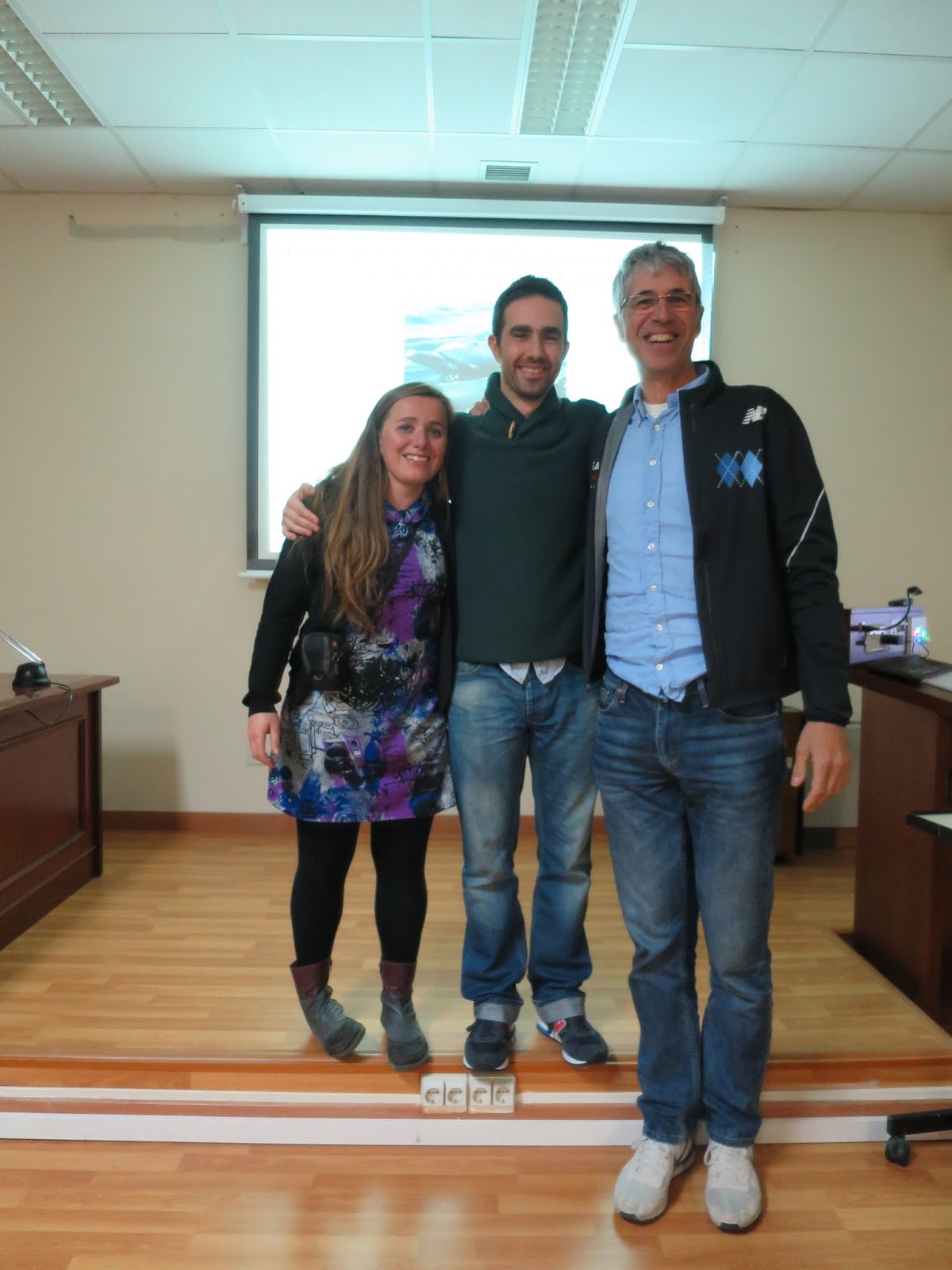
Carles Carboneras succesfully defended his Ph. D. titled: "Birds population dynamics in the wintering season: the case of  the Mediterranean Gull, Larus Melanocephalus" at the University of Barcelona.
Photo: C Carboneras
 

Carles' work focussed on the wintering startegy and migratory routes of Mediterranean Gulls marked in several breeding areas in middle and northern Europe.

The Ph.D was supervised by Dr G. Tavecchia and Dr. M. Genovart.


You can read Carles' s work here

Carboneras, C., 2016. Birds Population dynamics in the wintering season: the case of  the Mediterranean Gull, Larus Melanocephalus. University of Barcelona, Spain.
 
Well done Carles!


miércoles, 10 de febrero de 2016

Ph.D. defense : Sergi Pérez Jorge !!


Indiviudal dolphin with increasing marking level M1,M2 and M3 (photo: S. Pérez)
Sergi Pérez has successfully defended his Ph.D thesis on the ecology of the common bottlenose dolphin at the protected area Kisite-Mpunguti in Kenya. The thesis, supervised by Prof. D. Oro and Dr. M Louzao, has been presented the University of Cadiz (Spain).  You can read Sergi's work here.

Pérez, S. 2015. Ecologia del delfín Mular del Indo-Pacifico  en el área marina protegida de Kisite-Mpunguti, Kenia. Ph.D. Thesis, University of Cadiz, Spain.
 
Visca, Sergi!!!

miércoles, 27 de enero de 2016

New Publication on the role of anthropogenic areas for conservation

Martinez-Abrain, A. and Jimenez, J. 2016. Anthropogenic areas as incidental substitutes for original habitat. Conservation Biology. doi: 10.1111/cobi.12644.


Abstract:

One speaks of ecological substitutes when an introduced species performs, to some extent, the

ecosystem function of an extirpated native species. We suggest that a similar case exists for habitats. Species evolve within ecosystems, but habitats can be destroyed or modified by natural and human-made causes. Sometimes habitat alteration forces animals to move to or remain in a suboptimal habitat type. In that case, the habitat is considered a refuge, and the species is called a refugee.
Photo: Martínez-Abrain, A.
Typically refugee species have lower population growth rates than in their original habitats. Human action may lead to the unintended generation of artificial or semiartificial habitat types that functionally resemble the essential features of the original habitat and thus allow a population growth rate of the same magnitude or higher than in the original habitat. We call such areas substitution habitats and define them as human-made habitats within the focal species range that by chance are partial substitutes for the species’ original habitat. We call species occupying a substitution habitat adopted species. These are 2 new terms in conservation biology. Examples of substitution habitats are dams for European otters, wheat and rice fields for many steppeland and aquatic birds, and urban areas for storks, falcons, and swifts. Although substitution habitats can bring about increased resilience
against the agents of global change, the conservation of original habitat types remains a conservation priority

viernes, 15 de enero de 2016

The workshop on Applied Hierarchical models in Ecology ended


Theoretical aspects of site-occupancy ...
G.E.P. hosted the workshop on Modelling the distribution of species and communities accounting for detection using R and BUGS/JAGS by G. Guillera-Arroita, J.J. Lahoz-Monfort and M. Kéry.
.. and practical aspects of site-occupancy
Gurutzeta, José and Marc introduced the most useful models to estimate site-occupancy and they illustrated how to implement them using a frequentist ('unmarked') as well as a bayesian analytical framework ('JAGS', 'WinBugs'). 

http://store.elsevier.com/Applied-Hierarchical-Modeling-in-Ecology-Analysis-of-distribution-abundance-and-species-richness-in-R-and-BUGS/Marc-Kery/isbn-9780128014868/


It has been a wonderful occasion to learn about bayesian statistic, new developments and cutting-edge site-occupancy models. We had many inspiring talks on bayesian concepts, applcations and, above all, many priceless advices on how to analyse different types of data. Obviously, it has also been a good excuse to meet friends.


ps: find the supporting book by M. Kéry and A. Royle and some working examples here.


martes, 15 de diciembre de 2015

New publication on Lesser kestrel demography in Sicily!

Di Maggio, R., Campobello, D., Tavecchia, G. and Sará M. 2016: Habitat- and density-dependent demography of a colonial raptor in Mediterranean agro-ecosystems  Biological Conservation, vol 193 pag 116-123. doi:10.1016/j.biocon.2015.11.016

Abstract: Agricultural intensification is considered the major cause of decline in farmland bird populations, especially in the Mediterranean region. Food shortage increased by the interaction between agricultural intensification and density-dependent mechanisms could influence the population dynamics of colonial birds. We used demographic data on lesser kestrels (Falco naumanni), a key species of Mediterranean pseudo-steppes, to understand the importance of land-use changes and density-dependent mechanisms in the light of its fluctuating conservation status in the Western Palearctic. Our analysis indicated an important influence of land uses (artichokes, arable and grassland fields) and colony size on kestrel survival rates.
The strong habitat effect revealed the unsuitability of intensive arable lands with respect to extensive grasslands for lesser kestrels. Notably, artichokes, a winter-intensive crop, proved to be a high-quality habitat as they were associated with survival values equal to those of grassland. This is likely due to prey availability and reveals that non-traditional crops may provide suitable habitats for lesser kestrels. Information theory gave strong support to the negative influence of colony size on fecundity, albeit a small one, for its positive effect on survival probability. The estimated population growth rate was negative for all three habitats, indicating a decline over time and urging conservation actions in all of the areas studied. This decline was much higher in colonies surrounded by arable fields. In sensitivity analyses, λ indicated that adult survival was the parameter with the greatest effect on population growth, followed by survival of fledglings and fecundity. Our study showed how the costs and benefits of group living interact with agricultural intensification to drive species demography. In addition, we integrated significant information on one of the largest lesser kestrel populations to fine tune the most effective conservation strategy to prevent the collapse of the species in a relevant part of its range

viernes, 4 de diciembre de 2015

Science Speed Dating at the IMEDEA

Students from IES Politécnic at the IMEDEA
The GEP took part in the Science Week 2015. Students from high-schools and elementary schools visited the IMEDEA to know about the scientific activities of the Institute.


Ana Payo from the GEP explained how the scientific study of birds can help their conservation.