martes, 8 de marzo de 2016

EMBC+ Master project with the GEP

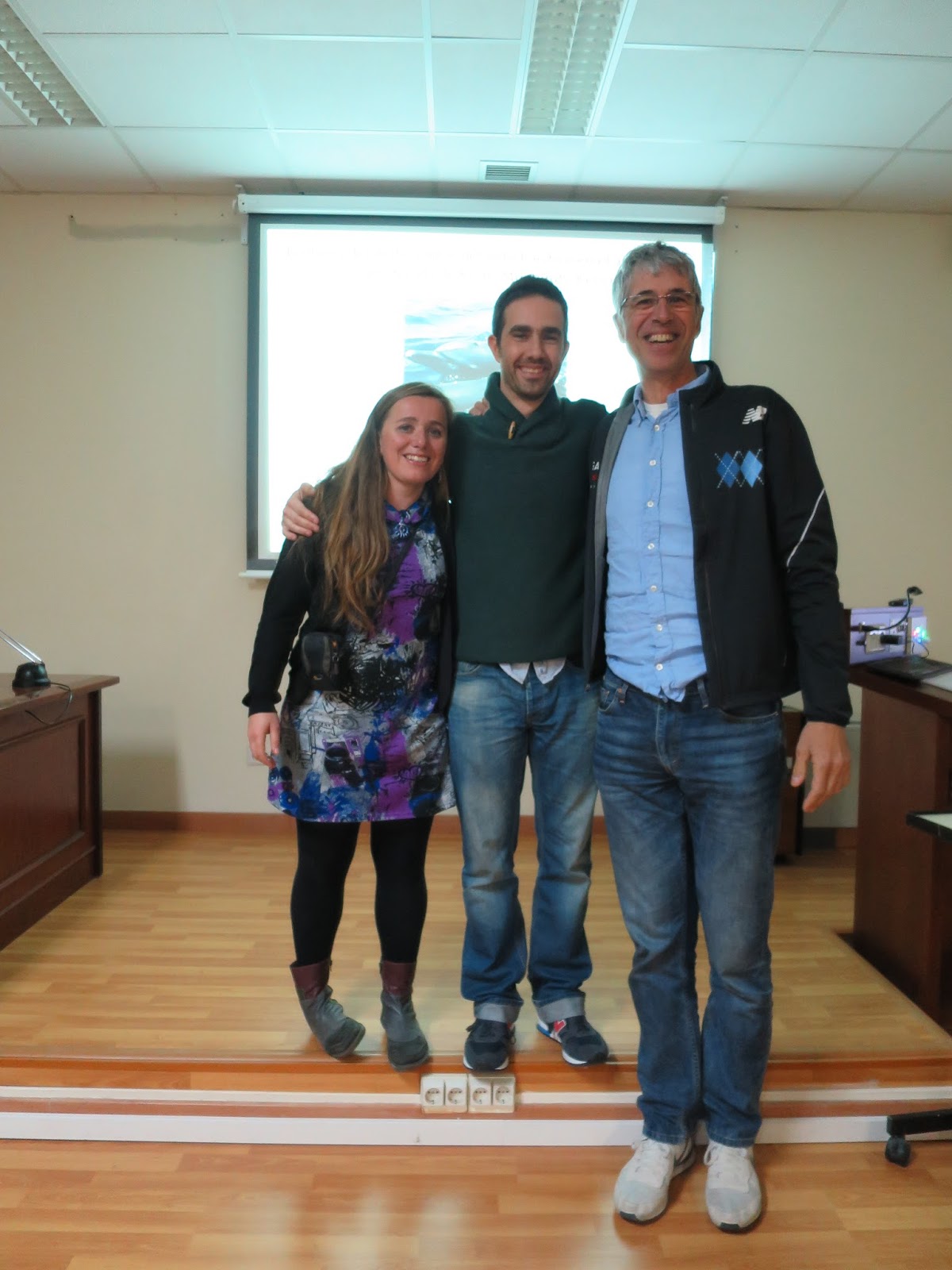
Lluïsa Ferrer Palou has joint the GEP to complete her Master project in Marine Biodiversity and Conservation (International Master of Science;  EMBC+).
Lluïsa will reveal predictors of the breeding success of Scopoli's Shearwaters using indivudal-based data collected in the Balearic Islands since 2001.

Welcome Lluïsa !!!

jueves, 3 de marzo de 2016

New Publication on Lilford's wall lizard !!


Rotger, A., Smith, J.J., Igual, J.-M. and Tavecchia, G., 2016: Relative role of population density and climatic factors in shaping the body growth rate of Lilford’s Wall Lizard (Podarcis lilfordi). Canadian Journal of Zoology. doi: 10.1139/cjz-2015-0188

 Abstract: The growth rate in small reptiles is modulated by per-capita food resources and recent evidence suggested that this constraint is the mechanism underlying differences between cohorts. Per-capita food resources depend on population size and climatic factors, but their relative role in explaining the variations in growth rate is unclear.
Photo: G. Tavecchia
We used morphological data collected over 6 years to model the body growth of an insular lizard (Lilford’s Wall Lizard, Podarcis lilfordi (Günther, 1874)). We used nonlinear equations to describe the appropriate length-at-age relationship. For each sex, seasonal growth was observed and the oscillatory von Bertalanffy curve was fitted to the data. Three age classes were recognized, and we investigated the relative role of density, spring rainfall, and temperature in explaining the variation of the growth rate in each sex-by-age class. Results showed that the relative role of density and climatic factors varied according to the age considered. While population size and temperature had a negative effect on the growth rate of juveniles, rainfall had a positive influence on the growth of subadults. Adult growth was near zero and constant over time. The different role of density-dependent and climatic factors in explaining age-dependent growth rate provides an important insight in understanding lizard population dynamics and life-history tactics.

jueves, 25 de febrero de 2016

Press release on EU "Science for Environmental Policy"

The work by Rosanna di Maggio et al.  on lesser kestrel demography has been mentioned in "Science for Enviornmental Policy" of the European Commission.
The study found that early-spring harvested crops, such as artichokes, offer a positive alternative habitat compared to those crops harvested in late spring.  Form the press note: "[...] Intensive activities in artichoke fields, including field preparation, planting, and fertiliser and pesticide applications, occur during the winter when lesser kestrels are in Africa. Artichoke fields are abandoned after mid-April harvesting, when birds come back to breed. Prey availability in the abandoned fields is usually high and sustains lesser kestrels during breeding [...]"


You can read the Press Release here and the original work by Rosanna, here.


miércoles, 17 de febrero de 2016

Ph.D. defense: Carles Carboneras Malet !

From Carboneras et al. 2013 Pop Ecol
Carles Carboneras succesfully defended his Ph. D. titled: "Birds population dynamics in the wintering season: the case of  the Mediterranean Gull, Larus Melanocephalus" at the University of Barcelona.
Photo: C Carboneras
 

Carles' work focussed on the wintering startegy and migratory routes of Mediterranean Gulls marked in several breeding areas in middle and northern Europe.

The Ph.D was supervised by Dr G. Tavecchia and Dr. M. Genovart.


You can read Carles' s work here

Carboneras, C., 2016. Birds Population dynamics in the wintering season: the case of  the Mediterranean Gull, Larus Melanocephalus. University of Barcelona, Spain.
 
Well done Carles!


miércoles, 10 de febrero de 2016

Ph.D. defense : Sergi Pérez Jorge !!


Indiviudal dolphin with increasing marking level M1,M2 and M3 (photo: S. Pérez)
Sergi Pérez has successfully defended his Ph.D thesis on the ecology of the common bottlenose dolphin at the protected area Kisite-Mpunguti in Kenya. The thesis, supervised by Prof. D. Oro and Dr. M Louzao, has been presented the University of Cadiz (Spain).  You can read Sergi's work here.

Pérez, S. 2015. Ecologia del delfín Mular del Indo-Pacifico  en el área marina protegida de Kisite-Mpunguti, Kenia. Ph.D. Thesis, University of Cadiz, Spain.
 
Visca, Sergi!!!

miércoles, 27 de enero de 2016

New Publication on the role of anthropogenic areas for conservation

Martinez-Abrain, A. and Jimenez, J. 2016. Anthropogenic areas as incidental substitutes for original habitat. Conservation Biology. doi: 10.1111/cobi.12644.


Abstract:

One speaks of ecological substitutes when an introduced species performs, to some extent, the

ecosystem function of an extirpated native species. We suggest that a similar case exists for habitats. Species evolve within ecosystems, but habitats can be destroyed or modified by natural and human-made causes. Sometimes habitat alteration forces animals to move to or remain in a suboptimal habitat type. In that case, the habitat is considered a refuge, and the species is called a refugee.
Photo: Martínez-Abrain, A.
Typically refugee species have lower population growth rates than in their original habitats. Human action may lead to the unintended generation of artificial or semiartificial habitat types that functionally resemble the essential features of the original habitat and thus allow a population growth rate of the same magnitude or higher than in the original habitat. We call such areas substitution habitats and define them as human-made habitats within the focal species range that by chance are partial substitutes for the species’ original habitat. We call species occupying a substitution habitat adopted species. These are 2 new terms in conservation biology. Examples of substitution habitats are dams for European otters, wheat and rice fields for many steppeland and aquatic birds, and urban areas for storks, falcons, and swifts. Although substitution habitats can bring about increased resilience
against the agents of global change, the conservation of original habitat types remains a conservation priority

viernes, 15 de enero de 2016

The workshop on Applied Hierarchical models in Ecology ended


Theoretical aspects of site-occupancy ...
G.E.P. hosted the workshop on Modelling the distribution of species and communities accounting for detection using R and BUGS/JAGS by G. Guillera-Arroita, J.J. Lahoz-Monfort and M. Kéry.
.. and practical aspects of site-occupancy
Gurutzeta, José and Marc introduced the most useful models to estimate site-occupancy and they illustrated how to implement them using a frequentist ('unmarked') as well as a bayesian analytical framework ('JAGS', 'WinBugs'). 

http://store.elsevier.com/Applied-Hierarchical-Modeling-in-Ecology-Analysis-of-distribution-abundance-and-species-richness-in-R-and-BUGS/Marc-Kery/isbn-9780128014868/


It has been a wonderful occasion to learn about bayesian statistic, new developments and cutting-edge site-occupancy models. We had many inspiring talks on bayesian concepts, applcations and, above all, many priceless advices on how to analyse different types of data. Obviously, it has also been a good excuse to meet friends.


ps: find the supporting book by M. Kéry and A. Royle and some working examples here.